
Your Semiconductor Quality Depends on Gas Purity: Highlights from Marc-Antoine Langevin’s CGA TECH26 Presentation
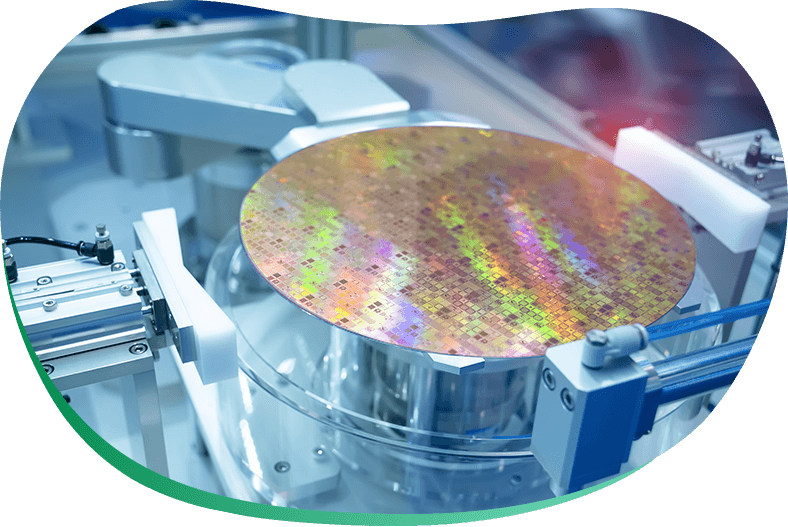
Your semiconductors can only be as good as the gas they are made with. That was the message Marc-Antoine Langevin, Application Director at ASDevices, brought to the compressed gas community at CGA TECH26 in Scottsdale, Arizona. Measuring gas purity at ppb and ppt levels takes more than a sensitive detector: the detector, valves, columns, flow controllers and calibration system all have to work together.
Marc-Antoine presented “EPD Technology for the Measurement of Ultra-trace Impurities in High-Purity Gases” on November 3, 2026, in the Plenary Session (11:05 to 11:35 AM MST, Sonoran Grand Ballroom). He co-authored the work with André Lamontagne and Yves Gamache. It draws on over three decades of gas chromatography (GC) innovation, over 200 patents, and technologies used today in most air separation plants and semiconductor fabs.
Why impurities matter, and where common analyzers fall short
Impurities in process gases cause defects in semiconductor materials. Because fabrication conditions are so extreme, even inert gases such as nitrogen and the noble gases (helium, argon, krypton, xenon) can do damage. Marc-Antoine framed the problem around two checkpoints:
- Incoming Quality Control (IQC): process or specialty gases arriving before on-site purification, typically with ppb to low-ppm impurities.
- Continuous Quality Control (CQC): process and specialty gases after purification, typically with low-ppb to ppt impurities.
Each mainstream technique covers part of that range, and each leaves a gap:
| Technique | Strengths | Limits |
|---|---|---|
| APIMS | 2-minute cycle, LOD below 10 ppt | Depends on the bulk gas: cannot measure O2 as a bulk gas, or Ar and Ne in H2 or N2 |
| CRDS | Gold standard for ppb/ppt H2O: very sensitive and selective, no consumables | Mirror misalignment from vibration, mirror contamination from particulates, high price, hard zero-point calibration. O2 only as a secondary, indirect measurement |
| Electrochemical O2 cell | Highly sensitive, selective to O2, fast response | KOH consumption, signal spikes, hard zero-point calibration, not compatible with CO2 |
| Gas chromatography | Separates virtually any impurity, 3 to 10 minute cycles for semiconductor use, easy to automate | Sensitivity depends on the detector. ppb-level H2O and O2 need another method (CRDS, electrochemical cell) |
ASDevices addressed the electrochemical gap in 2026 with a trace O2 analyzer that offers automated electrolyte control, spike removal and true-zero calibration.
EPD: ppt-level detection, with helium or argon
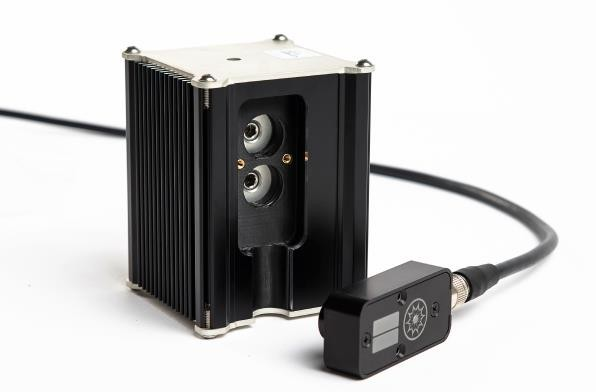
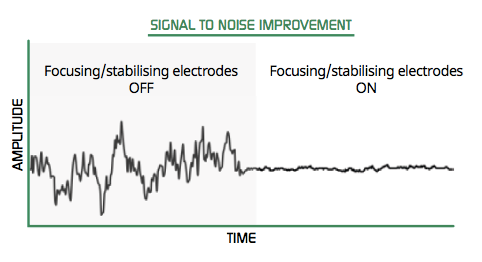
The Enhanced Plasma Discharge (EPD) detector reaches ppt-level detection limits with helium as carrier and discharge gas. It improves on the Plasma Emission Detector (PED), which Yves Gamache introduced to GC in the 1990s and which other companies still use, with patented stabilization and electron-injection electrodes (US Patent 10,379,054 B2).
| Detector | LOD | Gases | Notes |
|---|---|---|---|
| PDHID | About 25 ppb | Helium only | Universal detector. Its electrode is in direct contact with the discharge and needs maintenance. Suited to IQC, not sensitive enough for CQC |
| PED | 1 to 5 ppb (helium) | Helium or argon | One wavelength at a time. Sealed module that cannot be configured or maintained |
| EPD | ppt with helium, ppb with argon | Helium or argon | Up to 4 wavelengths, easy access to optical filters, spectral compensation |
GC-EPD can use argon as both carrier and discharge gas, so trace O2 and other permanent gases in argon are measured without interference from the argon itself, at low-ppb detection limits and lower cost. PDHID can only run on helium. CQC still generally requires helium, whose higher ionization energy enables sub-ppb detection.
ArDSieve: finally seeing trace argon
Argon is a critical impurity in semiconductor gases, yet it has been overlooked for years because it co-elutes with oxygen on most GC columns. A universal detector like PDHID cannot tell the two apart, so the combined peak is usually assumed to be oxygen. But argon is inert, which makes it harder to remove from ultra-high-purity (UHP) gases.
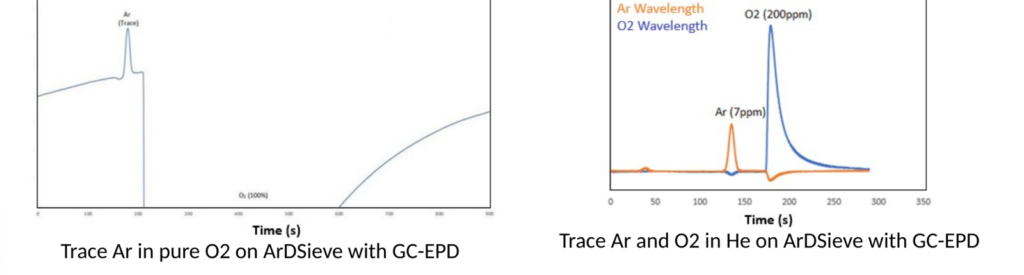
The ArDSieve column separates argon from oxygen, and EPD measures each at its own wavelength for much better speciation. One result stood out: UHP oxygen always contains trace argon (20 to 40 ppb). APIMS cannot measure oxygen as a bulk gas, and GC-PDHID cannot separate that argon from the oxygen without the ArDSieve column. GC-EPD with ArDSieve is the best option for trace argon.
Leak integrity starts with the valve and the flow controller
A sensitive detector is only as good as the flow path that feeds it. Conical rotary valves are prone to leaks, wear out in under 50,000 actuations, cannot be inert-treated and should never be used for UHP gas analysis. Diaphragm valves last 500,000 to 1,000,000 actuations and seal well with a purge, but they contain dead volume and their peaks shift over time.
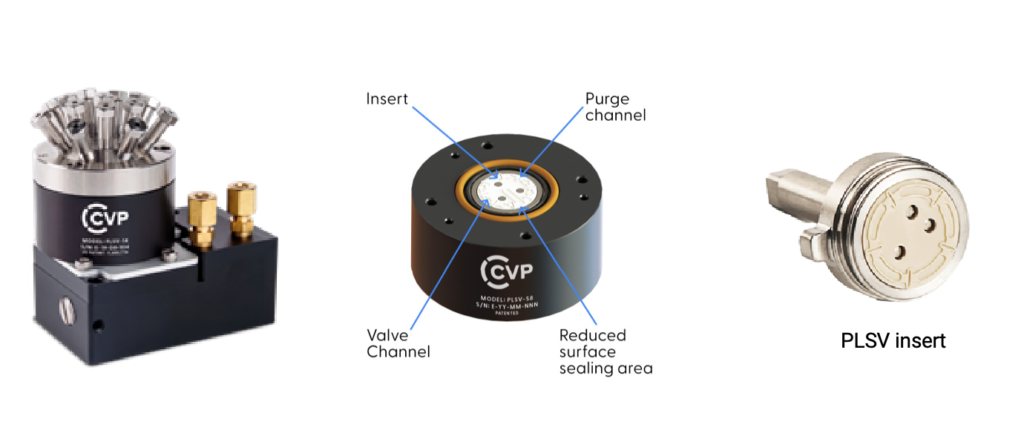
The Purged Lip Sealing Valve (PLSV, US Patent 11,885,774 B2) outlasts diaphragm valves while keeping the constant pressure drop and simplicity of a conical rotary valve:
- Over 3,000,000 actuations in UHP applications.
- Inboard, outboard and cross-port leaks are impossible, thanks to its purge design.
- Constant pressure drop across the temperature range and the life of the valve, and no dead volume.
- Surface treatments such as Sulfinert are possible, for reactive molecules like H2O and sulfur.
- Compact design, with a form factor 100% compatible with third-party systems.
The same logic applies to carrier gas control. Electronic pressure controllers (EPCs) have moving parts that can let air into the analytical path, so most UHP GCs use a bypass configuration, which burns more gas. ASDevices’ purged EPC sits inline, inside an inert atmosphere filled with carrier gas, and cuts gas consumption by up to 70%.
Calibrating at ppb levels with sonic orifices
CQC instruments typically measure 0 to 250 ppb or lower, and calibration works best at about 80% of the measurement range. That is hard to buy: a calibrated 10 ppm standard of permanent gases in argon already costs $1,000 or more, the cost rises as the concentration falls, and sub-ppm standards are almost impossible to find.
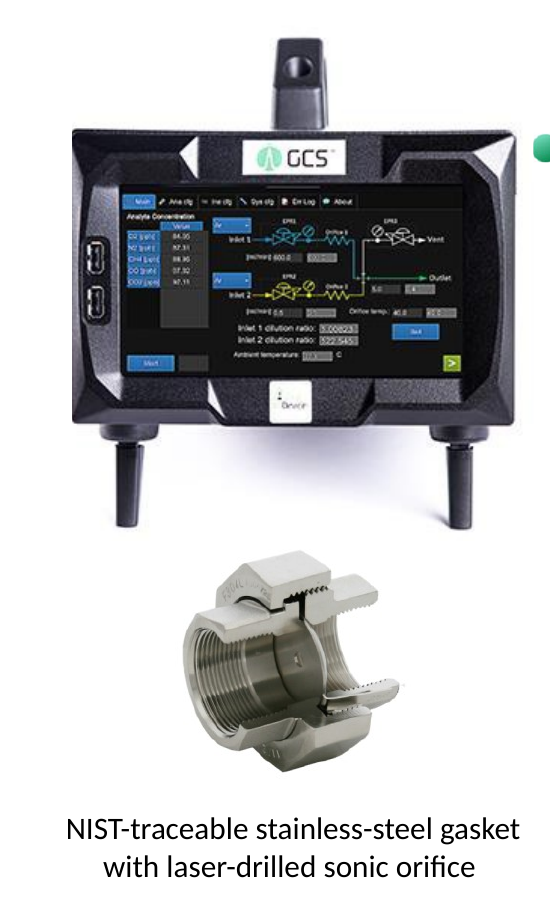
The usual workaround is to dilute a 10 ppm standard, but dilution systems built on mass flow controllers (MFCs) cannot generate accurate low or sub-ppb samples. At low flows they often drop out of the sonic regime, which causes large dilution errors, especially when mixing two different gases or using very high dilution ratios.
In the sonic regime, flow through an orifice depends only on the inlet pressure, so two gas flows blend accurately regardless of their nature. Marc-Antoine’s conclusion: dilution based on NIST-traceable, laser-drilled sonic orifices is essential to calibrate and validate CQC systems. It is the principle behind the ASDevices iGCS dilution system, with ratios from 1:2 to 1:3500.
Key takeaways
GC-EPD combined with a trace O2 analyzer can cover most IQC and CQC specifications with unprecedented detection limits, and most applications in air separation and specialty gases. Four points to remember:
- Argon is a practical carrier and discharge gas for IQC with GC-EPD, while helium remains the choice for CQC.
- Valves, columns and flow controllers decide whether leak integrity, and therefore data quality, is preserved.
- Trace argon in UHP oxygen can now be measured with GC-EPD and the ArDSieve column.
- Sonic-orifice dilution is essential to calibrate and validate CQC systems at ppb levels.
ASDevices shared a booth with partner Pure Gas Equipment Supply at TECH26. To discuss your own gas purity challenges with our experts, write to sales@asdevices.com or visit https://asdevices.com/industries/semiconductor-lcd-led-analytical-solution/.
